 Outsourcing & vendors
Data labeling outsourcing: how to choose a provider you can defend
Outsourcing data labeling for regulated AI comes down to two things vendor lists skip: neutrality and compliance depth. A scorecard for testing any provider on both.
Rupali Pahwa
6 min read
- Outsourcing & vendors
- Outsourcing
- Audit
Contents
Executive summary
When you outsource data labeling for regulated AI, you are really solving for two things most vendor lists skip: neutrality, meaning a partner that is not part of a competitor, and compliance depth, meaning a partner who can hand you an audit trail. Here is how to score any provider on both.
Why your data labeling outsourcing choice matters more now
A year ago, data labeling outsourcing came down to price and capacity. Most data annotation companies competed on exactly those two lines. That is no longer the whole picture. In June 2025, Meta took a 49 percent economic stake in Scale AI for about 14.3 billion dollars, valuing Scale at roughly 29 billion. Scale still runs as an independent company, and Meta reportedly holds no voting power. But the deal changed the question every buyer now has to answer on the record: is your training data pipeline running through a company that a frontier lab partly owns?
You do not have to guess how much that matters. After the deal, several of Scale’s largest customers, including Google, OpenAI, and xAI, reduced or paused their work over data confidentiality concerns. Those companies have their own legal teams and leverage, and they still walked. If neutrality were only a theoretical worry, they would have stayed.
So the decision, whether you are weighing a Scale AI alternative or keeping your current vendor, splits into two real intents:
- Neutrality - a labeling partner with no frontier lab ownership tied to your data.
- Compliance depth - a partner who can prove how your data was labeled when a regulator or an auditor asks.
Most vendor lists rank providers on speed and cost. Those still matter. But if your model touches regulated, sensitive, or high-stakes data, these are the two intents that will surface in a due diligence review or an audit, and they are the ones worth leading with.
Who you are actually defending to
“Defend” sounds abstract until you name the person on the other side of the table, which is where a data labeling outsourcing decision gets real. In practice, it is usually one of four. An enterprise procurement team that will not sign until your subprocessors are documented. A regulator or an internal auditor who wants to see how a decision was made, not hear that it was made carefully. A large customer running their own vendor risk review on you. And, in the worst case, opposing counsel, if a labeling decision ever becomes contested. None of them accepts adjectives. They accept records. That is the standard the two tests below are built to meet.
The vendor neutrality test (about twenty minutes)
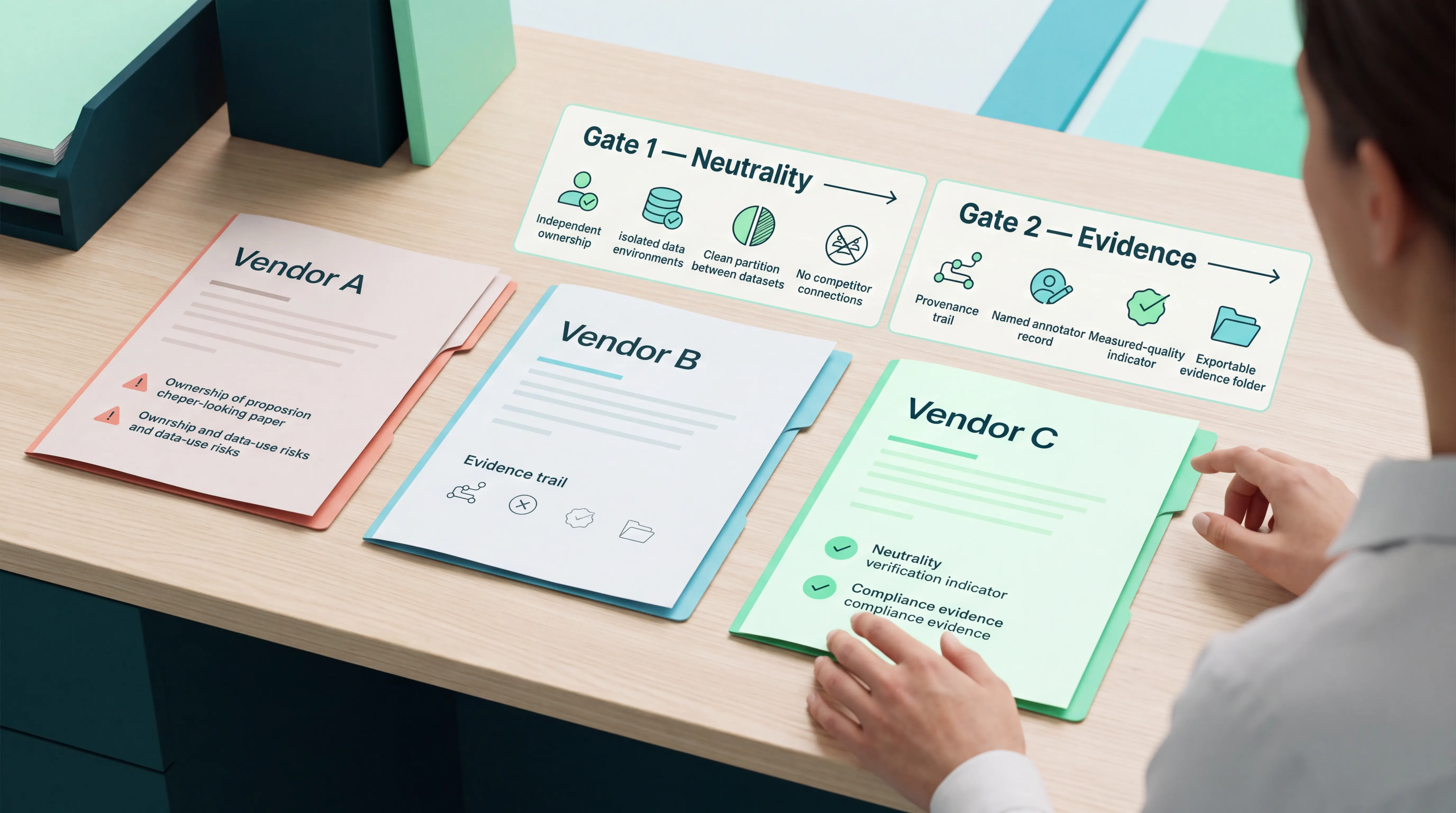
Neutrality is the first half of any data labeling outsourcing decision, and you can test it in a single call. Ask four questions and pay attention to how fast the answers come back.
- Ownership - who owns more than 10 percent of the company? Is any frontier lab or hyperscaler on the cap table? Get it in writing, not as a reassurance on a sales call.
- Data isolation - does your data ever train the vendor’s models, or an affiliate’s? You want a contractual no, not a warm “we would never.”
- Subprocessor list - who downstream actually touches your data, and where do they sit? A vendor that can’t produce this list within a day doesn’t fully control its own pipeline.
- Conflict walls - if they serve a direct competitor of yours, what separates the two teams and the two datasets? “Trust us” is not a wall. Look for named controls: separate environments, access logs, staff who cannot cross over.
None of these are trick questions. A provider built for neutrality answers them plainly. A provider that gets uncomfortable with them has just told you something too.
The compliance depth test
Neutrality protects your position. The second half of a data labeling outsourcing decision, compliance depth, protects your ability to ship. Here is what a defensible partner can actually produce.
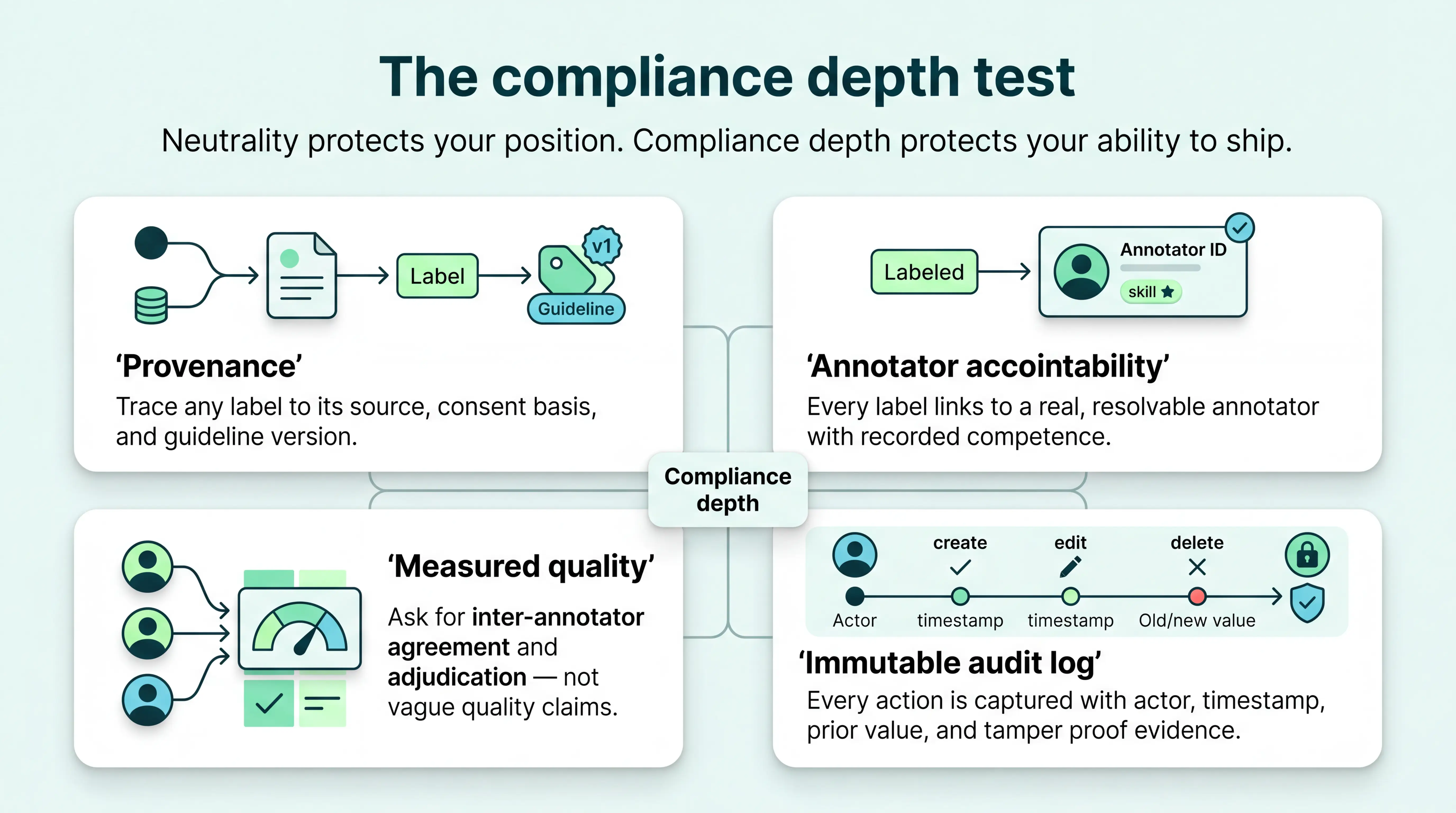
- Provenance - trace any single label back to its source, the consent basis for using it, and the exact guideline version in force when it was made.
- Annotator accountability - every label ties to a real, resolvable annotator whose competence is on record, not anonymous crowd output you cannot question later.
- Measured quality - ask for inter-annotator agreement and an adjudication process, not “high quality” as an adjective. A vendor who measures quality can give you a number in a sentence. A vendor who asserts it sends a brochure.
- Immutable audit log - every create, edit, and delete is captured with the actor, a timestamp, the prior value, and tamper evidence. This is the difference between a story about your data and a record of it.
- Export - a documentation pack mapped to your regime, whether that is DPDP, HIPAA, or SOC 2, that you can hand over without a scramble.
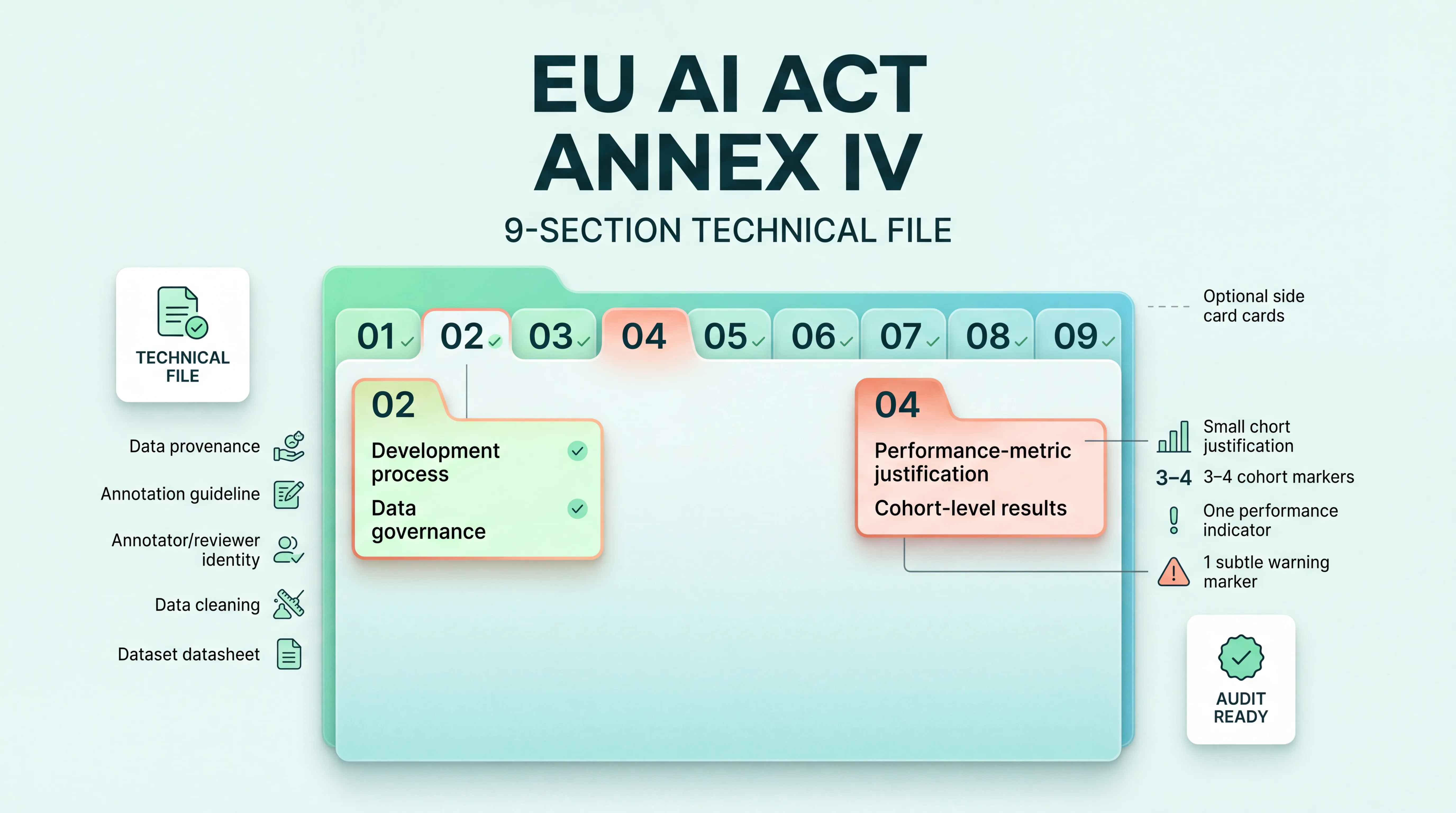
If you build systems that fall under the EU AI Act, the technical documentation duties in Annex IV expect exactly this kind of trail, and the high-risk obligations apply from 2 December 2027. The log you skip today is the one you end up rebuilding under pressure later.
Score any provider on both
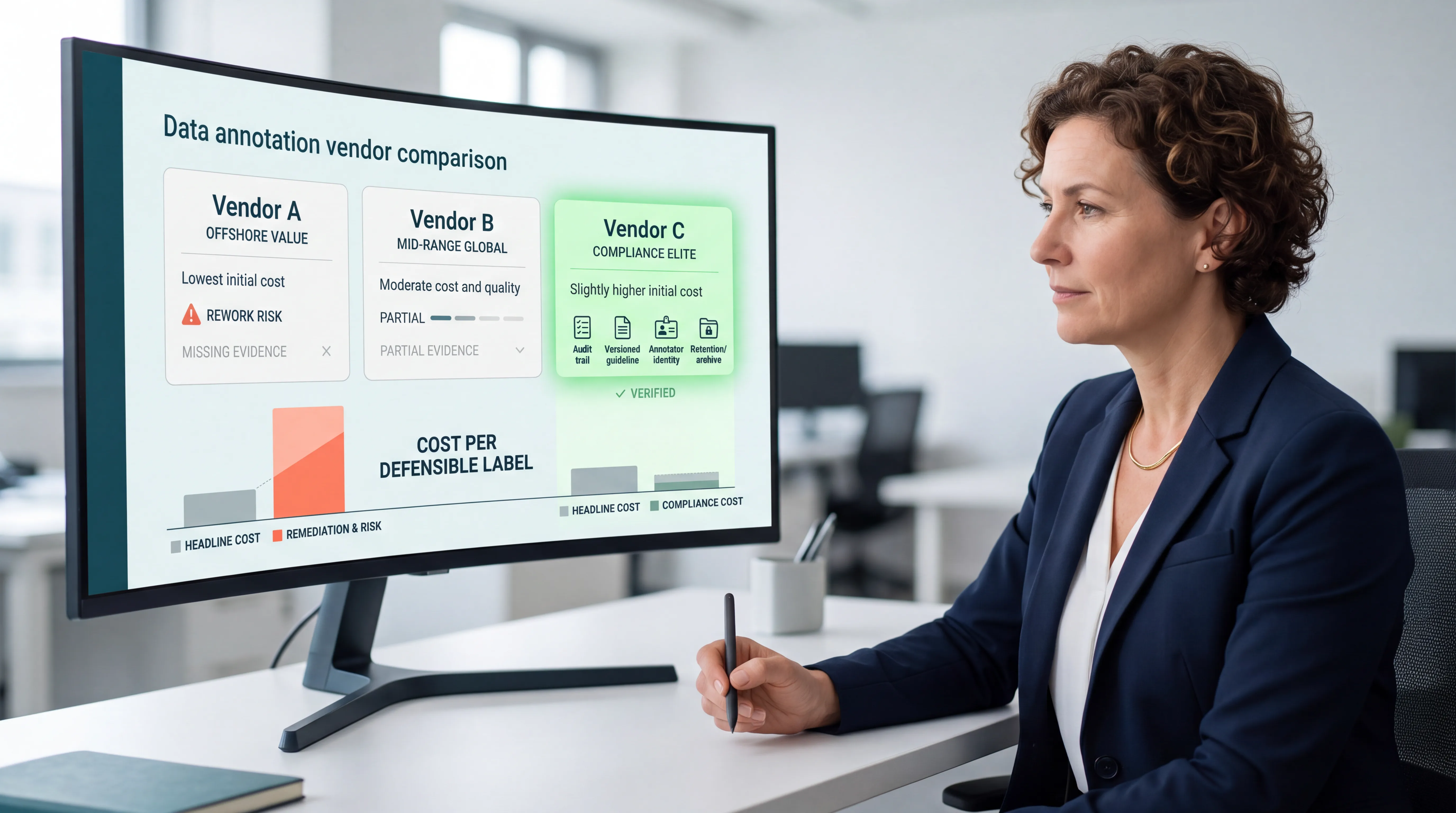
Here is the scorecard for a data labeling outsourcing decision. Run each provider against these dimensions. The point is not the label on the box, it is whether the answer comes back as evidence or as an adjective.
| Dimension | Defensible answer | Red flag |
|---|---|---|
| Ownership | Cap table shared in writing, no frontier lab over 10 percent | “We are independent,” no document to back it |
| Data use | Contractual no on training their models with your data | Vague assurance, broad license buried in the fine print |
| Subprocessors | Current list produced the same day | Cannot say who touches your data |
| Provenance | Label traces to source, consent, and guideline version | Labels arrive with no lineage |
| Annotators | Named, competence on record | Anonymous crowd, no recourse |
| Quality | Inter-annotator agreement plus adjudication | “High quality,” no number offered |
| Audit log | Immutable, with actor, timestamp, prior value | Editable spreadsheet, no history |
| Export | Pack mapped to your regulatory regime | You assemble the evidence yourself |
If a provider comes back green down the left side, price and speed become a fair negotiation. If they come back red, a low price per label is quietly buying you a liability.
Where LabelFort fits, and where it does not
LabelFort, Predusk’s data annotation platform, is built for those two intents: no frontier lab ownership, and an evidence trail on by default rather than bolted on after the fact. That is the whole design brief.
Not every data labeling outsourcing job needs this. It is not the right call for the absolute lowest price per label on a massive, low-stakes consumer dataset. Cheaper crowds exist for that, and you should use them when the data isn’t sensitive, and no one will ever ask you to defend it. LabelFort earns its place when the data is regulated, sensitive, or headed into a system you will have to stand behind.
Next step
Good data labeling outsourcing comes down to evidence over adjectives. Run the table against your current provider before you talk to anyone new. If most rows come back green, you are in good shape and don’t need us. If a few come back red, that is worth a conversation. We’ll review your existing annotation setup and tell you what works and what doesn’t.
Bring your current setup. We will score it against the same table and show you the gaps.
Recommended for you
Outsourcing & vendors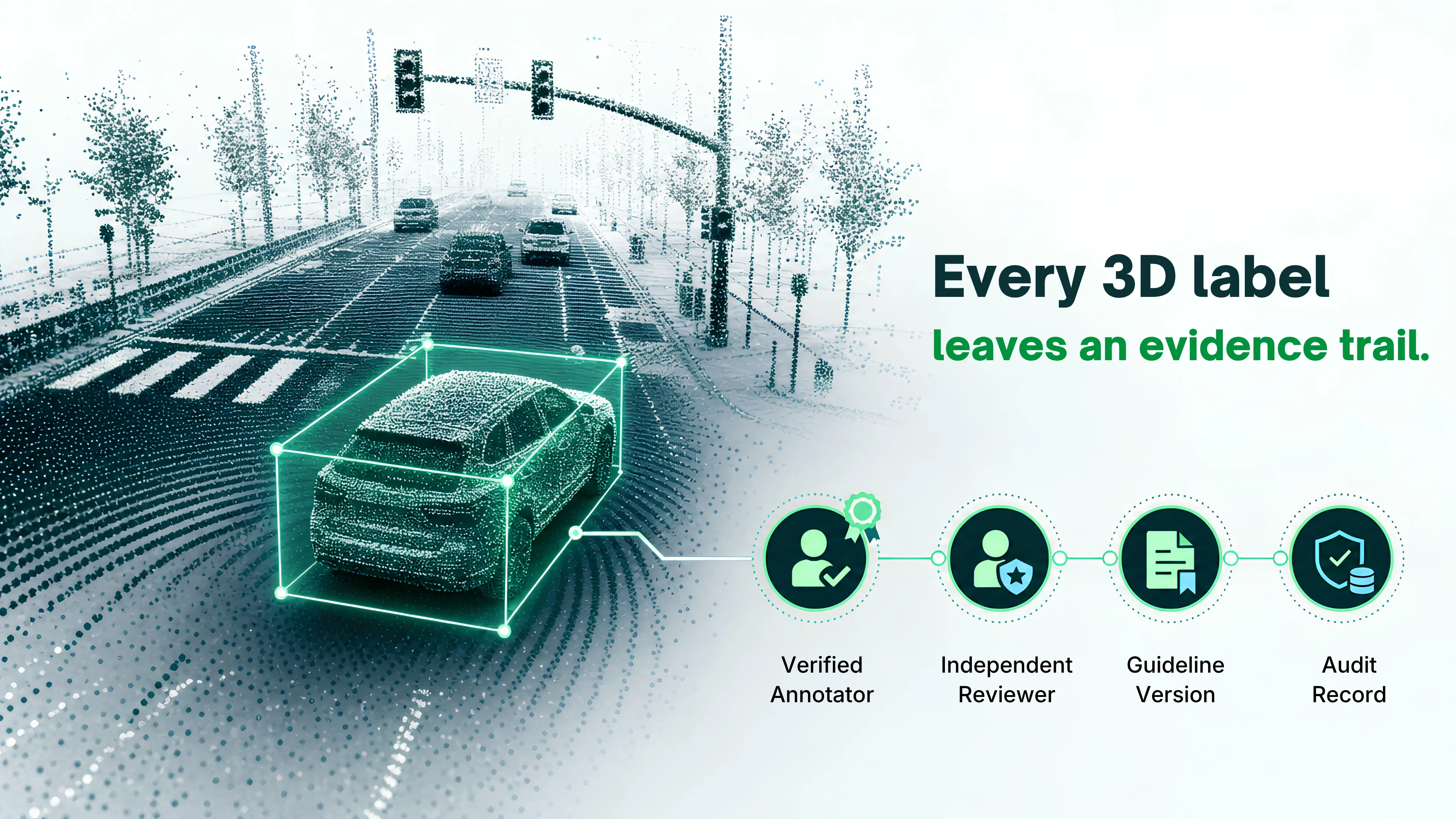 Annotation practice
 Regulation & compliance
This is the evidence LabelFort ships by default.
IAA scored per cohort, audit trails on every action, evidence exports mapped to EU AI Act Articles 10 & 12.
Certifications & readiness