 Outsourcing & vendors
Audio annotation services for speech AI: what good looks like and when to outsource
How to judge audio annotation services for speech and voice AI: what they include, how to measure quality, when to outsource audio annotation, and the questions to ask a provider before you send any recordings.

Rupali Pahwa
· 6 min read
- Annotation practice
- Audio annotation
- Speech AI
- Outsourcing
Contents
Executive summary
Audio annotation services turn raw recordings into training data by transcribing speech, marking time boundaries, separating speakers, and tagging intent, emotion, or sound events. Outsource audio annotation when volume, language coverage, or reviewer expertise outgrow your team, but only to a provider that measures agreement, controls who hears the audio, and can show you a record of every change.
What do audio annotation services include?
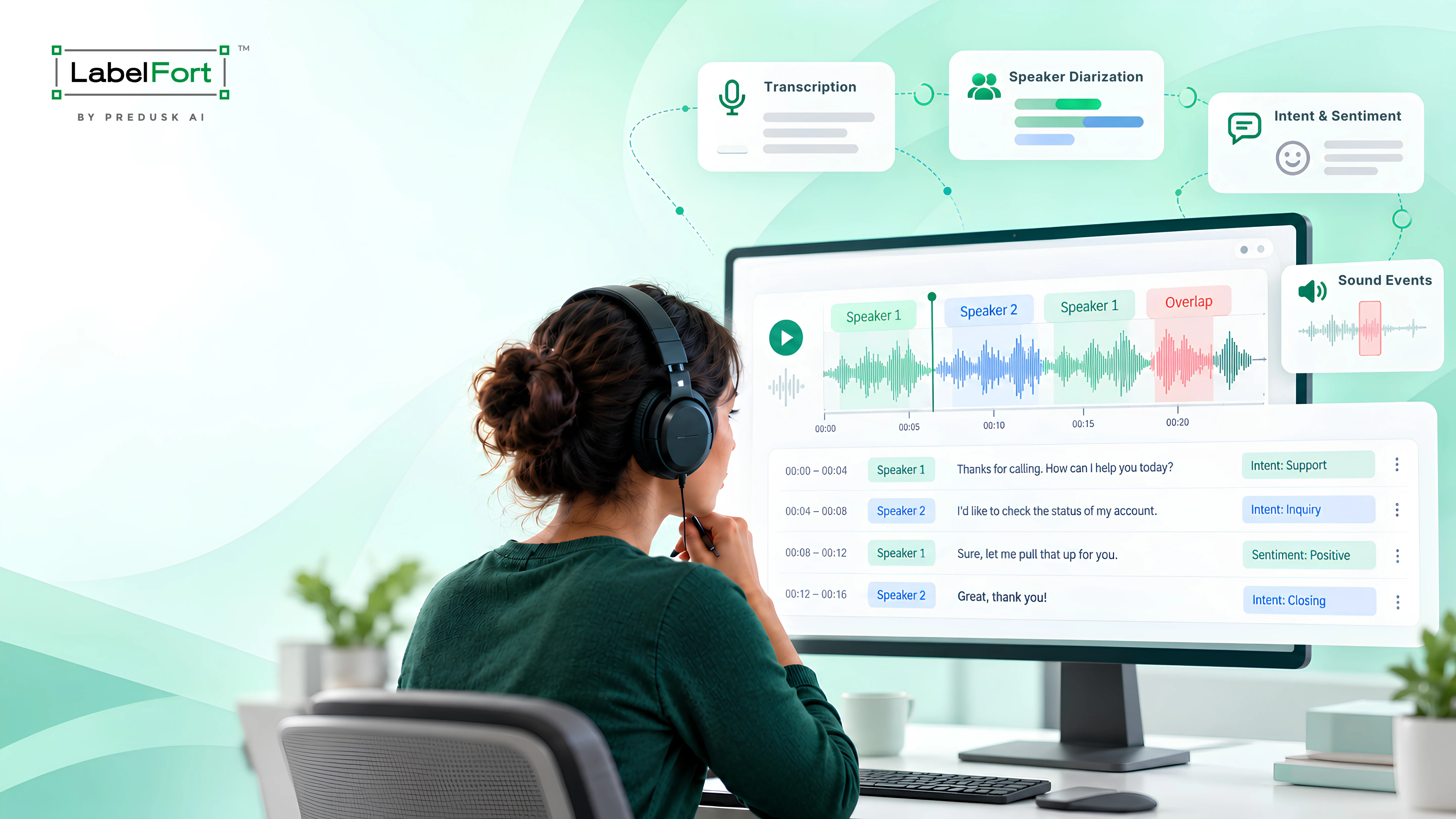
Most audio annotation services cover the same five task families:
- Transcription - verbatim (with fillers, false starts, and repairs) or clean read, depending on what the model needs to learn.
- Segmentation and timestamping - marking where each utterance, word, or event starts and ends on the waveform.
- Speaker diarization - labeling who spoke when, including the stretches where two people talk at once.
- Classification and intent tagging - assigning intent, sentiment, language, or topic to a segment.
- Sound event detection - tagging non-speech audio such as alarms, coughs, keyboard noise, or machinery.
The task list looks almost identical on every vendor page. The difference sits in how each task is checked, and that is where most audio labeling projects quietly go wrong.
Why is audio annotation harder than it looks?
Three things make audio annotation different from image or text work.
Time is continuous. A bounding box is either on the object or it is not. A speech boundary placed 300 milliseconds early clips the first syllable, and the model learns a wrong onset from thousands of examples like it.
Overlap is normal. In contact center calls and clinical consults, people interrupt, agree, and talk over each other. A pipeline that forces one speaker per segment deletes real data and hides the deletion.
The audio itself carries sensitive data. A patient reads out a date of birth. A customer reads out a card number. Under the GDPR, a recording that identifies a person is personal data, and it becomes special category biometric data when it is processed to uniquely identify someone (Article 9). In US healthcare, recorded clinical conversations carry protected health information under HIPAA.
This is why the audio annotation tool matters as much as the people using it. A reviewer has to see the waveform closely enough to spot the problem. On LabelFort, reviewers zoom from the full file down to a 250 millisecond window, and boundaries are stored at 1 millisecond granularity, so the timestamp a reviewer reads is the timestamp that gets exported.
How should you measure audio annotation quality?
A single accuracy percentage tells you very little. Ask for the metric that matches each task:
| Task | What to ask for |
|---|---|
| Transcription | Word error rate against a gold set checked by a second reviewer |
| Segmentation | Share of boundaries within an agreed tolerance of the gold boundary, for example 50 milliseconds |
| Diarization | Diarization error rate, which combines missed speech, false alarms, and speaker confusion |
| Classification and intent | Inter-annotator agreement, usually Cohen’s kappa |
On LabelFort projects, the agreement threshold for classification work sits above 0.90 Cohen’s kappa, and every edit lands in an audit log with 100% coverage.
A provider that quotes accuracy without naming the metric, the gold set, or who reviewed it is giving you an adjective, not a measurement.
Should you outsource audio annotation or keep it in house?
Keep it in house when
- Volume is small and comes in one language.
- Your guidelines are still changing every week.
- Your researchers need to hear the edge cases themselves.
Outsource audio annotation when
- Volume is steady and growing faster than your team.
- You need languages, accents, or dialects nobody on staff speaks.
- The work needs domain reviewers, such as clinical, financial, or legal specialists.
- Annotation hours are pulling ML engineers away from model work.
The setup that works for most teams is a hybrid. Write the guidelines and build the gold set in house, send production volume to audio annotation services, and keep a small slice back for blind audit. That slice tells you whether quality is holding without asking the provider to grade its own work. For the wider vendor decision, see our data annotation outsourcing guide.
What should you ask an audio annotation services provider?
- Which metric do you report for each task, and against which gold set?
- How do you handle overlapping speech: kept, split, or dropped?
- Who can hear our audio, from where, and on which devices?
- Can you show me the full edit history of a single segment?
- How is spoken personal data (names, numbers, addresses) redacted or controlled?
- What happens to finished work when the guidelines change halfway through?
One more check if your audio labeling includes emotion tags on employee speech, such as agent tone in contact center calls. Under Article 5 of the EU AI Act, emotion recognition in the workplace has been prohibited since 2 February 2025, outside medical and safety uses. Settle the use case with your legal team before you label for it.
Audio annotation tool or managed service?
An audio annotation tool gives your team the waveform view, span marking, review queues, and export. A managed service adds trained people, guidelines support, and quality management. If you already have reviewers, a tool may be all you need. If you do not, buying a tool just moves the staffing problem onto your own team.
Many regulated teams end up needing both, which is why it helps when the platform and the service are the same thing. You get one audit trail instead of two that have to be reconciled at audit time.
Where LabelFort fits, and where it does not
LabelFort is Predusk AI’s audit-ready data annotation platform for regulated teams: AI-assisted labeling checked by trained human reviewers, with the evidence trail Compliance, Legal, and Procurement expect.
For audio annotation, that means waveform span marking at millisecond precision and speaker diarization run as an AI pipeline step, with overlapping speech kept as returned rather than flattened into one speaker, followed by human review. Regulated projects run on an on-premises annotation floor in India with no paper, phones, or personal devices admitted, named entry and exit logs, and no remote work. Predusk holds ISO 27001:2022 certification and runs above 98% SLA adherence.
LabelFort is not the cheapest route for bulk transcription of public, nonsensitive audio with no audit requirement. A crowd platform will usually do that faster and for less. LabelFort earns its place on audio that carries patient, customer, or financial data, feeding models someone will one day have to defend. For high-risk systems in the EU, Article 10 of the AI Act sets data governance requirements for training data, with high-risk obligations applying from 2 December 2027.
Next step
The quickest way to judge audio annotation services is to pick your hardest file: two speakers talking over each other, background noise, a few spoken numbers. Ask each provider to annotate it and send back the edit history with it. How they answer will tell you more than any sales deck.
This post is general information, not legal advice.
FAQs
What are audio annotation services?+
Audio annotation services turn raw recordings into training data for speech and voice AI. The work covers transcription, time boundaries, speaker diarization, intent and emotion tagging, and sound event detection, each checked against a measured quality standard.
What is the difference between audio annotation and audio labeling?+
The terms are used interchangeably. Audio labeling sometimes refers to assigning a class to a whole clip, while audio annotation covers the wider job, including timestamps, transcripts, and speaker turns inside the clip.
When should a team outsource audio annotation?+
When volume is steady and growing, when you need languages, accents, or domain reviewers your team lacks, or when annotation hours are pulling ML engineers away from model work. Keep the guidelines and the gold set in house.
Recommended for you
Outsourcing & vendors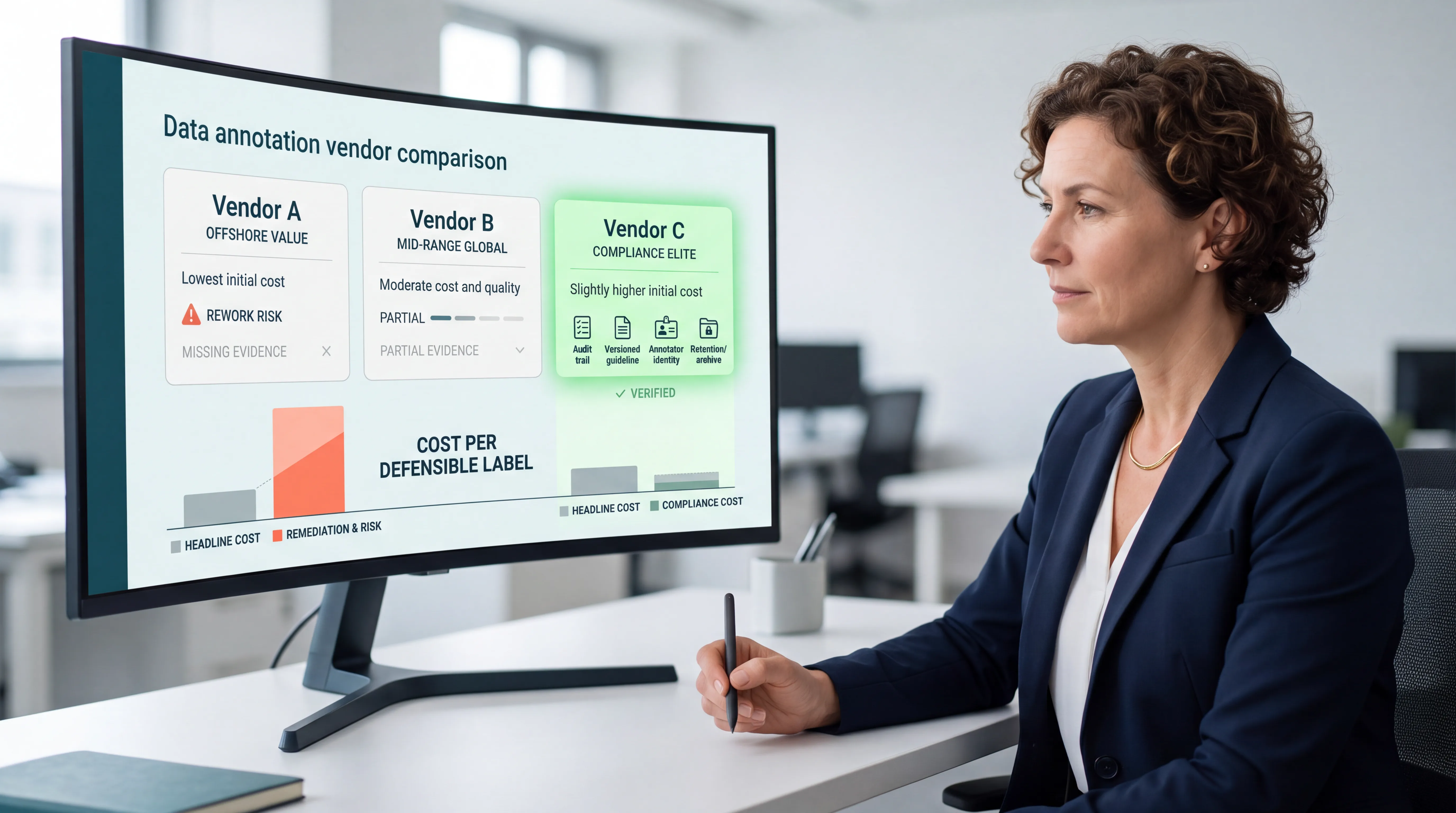 Outsourcing & vendors
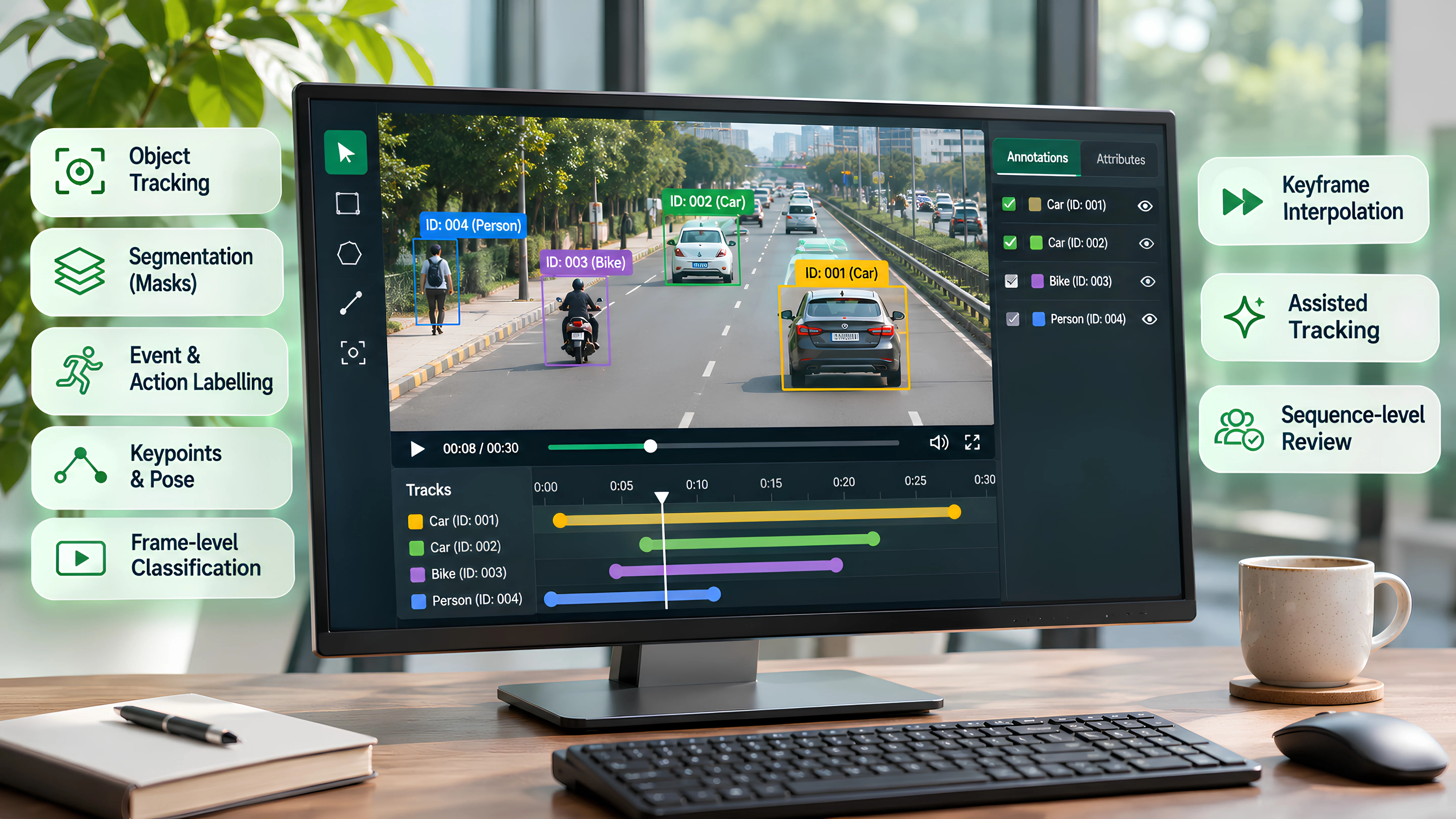 Annotation practice
· 5 min read
Video annotation: a practical guide
This is the evidence LabelFort ships by default.
IAA scored per cohort, audit trails on every action, evidence exports mapped to EU AI Act Articles 10 & 12.
Certifications & readiness