 Annotation practice
5 min read
How to choose a text annotation tool for NLP annotation and RLHF data: entities, intent, sentiment, preference ranking, and quality you can prove.

Chandra Prakash
· 5 min read
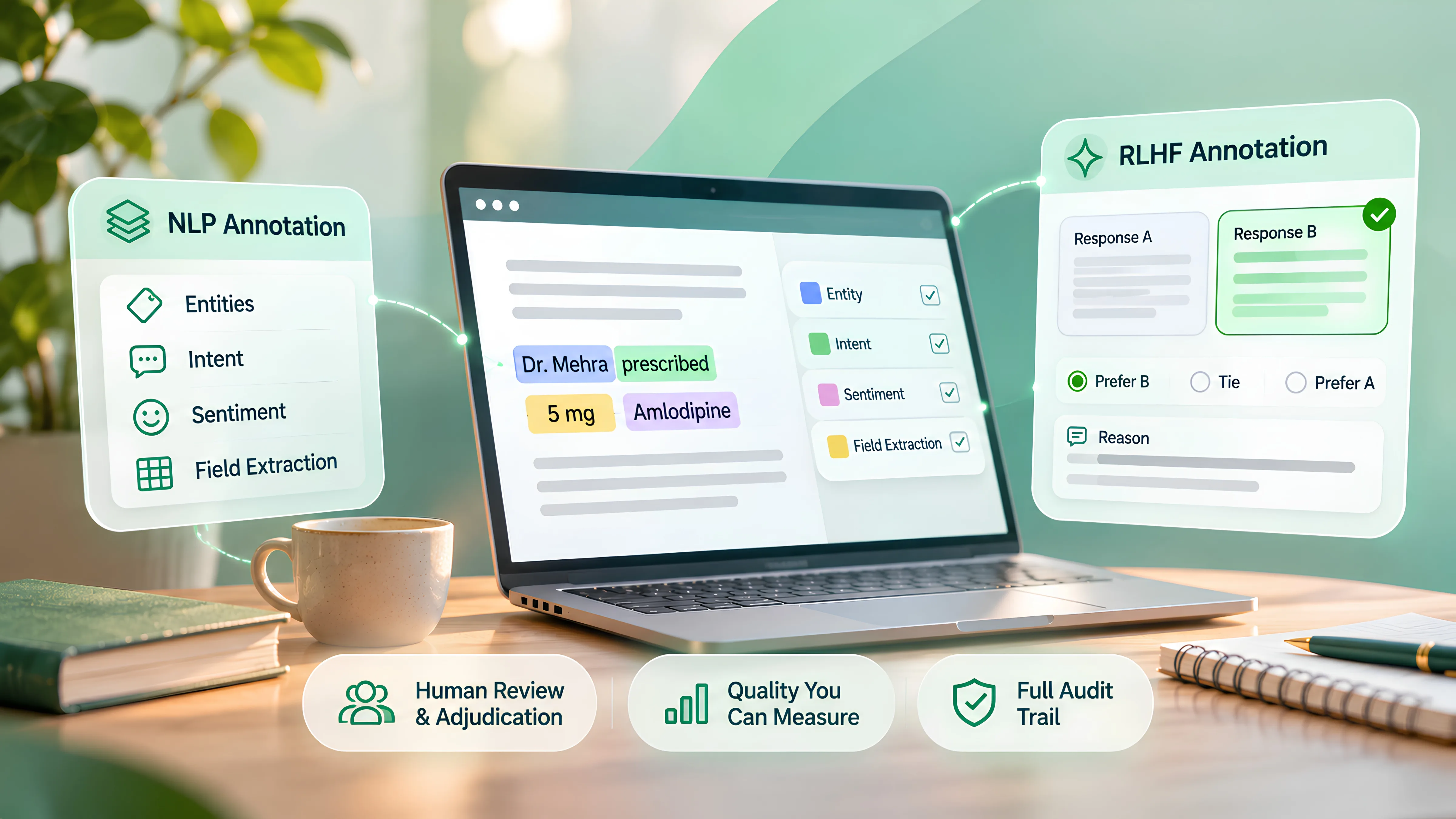
A text annotation tool for LLM work has to do two jobs. It must handle classic NLP annotation, such as entities, intent, sentiment, and field extraction, and it must collect RLHF data, where trained reviewers rank or score model outputs. The text annotation software worth buying records who labelled what, how reviewers agreed, and why each disagreement was settled.
Most teams spend months choosing a model and a few days choosing a text annotation tool. That order is backward. A large language model learns what good looks like from the examples and judgments people give it, and those examples are produced inside a text annotation tool. If the tool makes it easy to label fast and hard to label consistently, the model inherits the inconsistency.
The quality of that human signal is now a product decision, and your text annotation software is where that signal is created, checked, and stored.
NLP annotation is still the base layer. Before you test RLHF features, confirm that the text annotation tool does the everyday work well. In practice that means:
Two less obvious checks separate good text annotation tools from average ones. First, the guidelines should live inside the task, next to the text, not in a PDF the annotator opened once. Second, the tool should let you change the schema mid project and show which earlier labels were made under the old version. Schemas always change. The question is whether your NLP annotation history survives the change.
RLHF data is not a label on a fixed piece of text. It is a judgment about model behavior. A reviewer sees a prompt and two or more responses, then ranks them, scores them against a rubric, or rewrites the best one. That changes what a text annotation tool must support:
The biggest difference is how you treat disagreement. In entity labelling, two annotators who disagree usually means one is wrong. In RLHF data, disagreement is often real signal: the prompt is ambiguous, or the rubric is unclear. A text annotation tool built for RLHF records the disagreement, routes it to an adjudicator, and keeps both the original judgments and the final call. If the tool simply averages the votes, you lose the information your model team needs most.
Every vendor of text annotation software says its quality is high. Ask a sharper question: what is your inter annotator agreement on my task type, and how is it measured? A team that measures quality can answer in one sentence.
For LabelFort, Predusk AI’s data annotation platform, the working threshold is inter annotator agreement above 0.90 Cohen’s kappa, with SLA adherence above 98 percent. Agreement alone is not enough, though. Quality that holds up usually rests on three habits:
This matters for NLP annotation and for RLHF data alike. When a model behaves badly in production, the first question is what it was taught. A text annotation tool with a complete record lets you trace a behavior back to the examples and the reviewers behind it.
Text is where sensitive data hides. Clinical notes, claims, call transcripts, and contracts carry names, diagnoses, and account details in free form. For teams in healthcare, finance, and legal, the text annotation tool is part of the compliance boundary.
Two dates are worth knowing. Under the EU AI Act, obligations for high-risk systems now apply from 2 December 2027, and Article 10 asks providers to show governance over training, validation, and testing data. In India, the substantive obligations of the DPDP Act take effect on 13 May 2027. Both point the same way: you will be asked to show how your training data was prepared, by whom, and under what controls.
Software controls cover part of that. The rest is physical and human. LabelFort pairs the platform with trained reviewers working on a secure annotation floor in India, where phones, paper, and personal devices are not admitted and entry and exit are logged. The platform is ISO 27001:2022 certified, SOC 2 aligned, HIPAA ready, GDPR compliant, and DPDP Act 2023 ready.
Use these questions in your next vendor call. They work for any text annotation tool, ours included:
If your project is millions of low-stakes sentiment tags where speed and volume matter most, a crowd platform will often cost less. LabelFort earns its place when the text is sensitive, the judgments need domain knowledge, and someone outside your team will later ask how the data was made. That covers clinical NLP annotation, financial document extraction, and RLHF data for models that will face a regulator, an auditor, or a demanding customer.
The text annotation tool you choose decides more than labelling speed. It decides whether you can stand behind your model’s training data when it matters. Pick the one that lets you show your work.
See how LabelFort handles text annotation and RLHF data at labelfort.ai.
Annotation practice· 5 min read
 Annotation practice
 Annotation practice
IAA scored per cohort, audit trails on every action, evidence exports mapped to EU AI Act Articles 10 & 12.
Certifications & readiness